Introduction
“What is philosophy?” is a simple question only in appearance. In casual use, the word philosophy often means a personal outlook, a slogan, or a set of opinions about life. In academic use, however, philosophy names a disciplined form of inquiry: it asks what reality is, how knowledge is possible, what counts as good reasoning, and how human beings should live. This distinction matters because philosophy is sometimes dismissed as mere speculation or treated as an outdated rival to science. Both views are too narrow. Philosophy does not replace empirical investigation, but it examines the assumptions, concepts, and values that shape inquiry in the first place. This essay argues that philosophy is best understood as disciplined, critical inquiry into the most general conditions of reality, knowledge, and value: neither idle opinion nor displaced science, but a reflective practice that clarifies assumptions, tests arguments, and guides judgment.
Philosophy’s Object and Scope
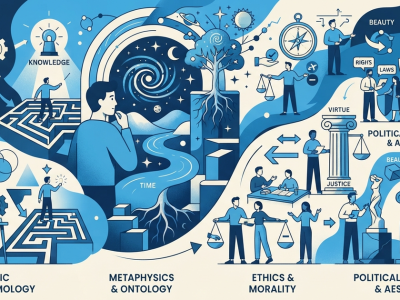
Philosophy first needs to be defined by what it asks about, not by the fact that it asks “big questions.” At its broadest, it is the love of wisdom and the effort to understand reality deeply, but academic philosophy gives that effort a disciplined structure: ontology asks about being, epistemology asks about knowledge and justification, and axiology asks about value (Sirait & Faruqi, 2025). This branch structure keeps philosophy from becoming a loose attitude toward life. Gul (2021) sharpens the epistemological side by treating knowledge, truth, justification, and the limits of knowing as central philosophical problems, not merely personal concerns. Likewise, Shramko (2019) links objects such as truth, justice, and the good to philosophy’s concern with qualitative features of being. Philosophy, then, is broad because its objects are basic: being, knowing, and valuing underlie more specialized forms of inquiry.
That breadth, however, has to be qualified so the definition does not become empty. Philosophy is often described as comprehensive and universal because it does not restrict itself to one empirical domain in the way specialized sciences do; it asks about the wider conditions within which domains of knowledge make sense (Sirait & Faruqi, 2025). Yet Shramko (2019) warns that definitions of philosophy as the study of everything general or abstract can become rhetorical if they do not specify philosophy’s distinctive object. His proposed correction is to understand philosophy as concerned with the pure qualitative attributes of being, while mathematics concerns the quantitative attributes of possible being (Shramko, 2019). This distinction is useful because it preserves philosophy’s wide scope without making it shapeless. Philosophy is not “about everything” in a vague sense; it studies the most general qualitative conditions that make reality, knowledge, and value intelligible.
Philosophical Method and Justification
If philosophy’s object is the general structure of reality, knowledge, and value, its method is disciplined questioning rather than loose reflection. Philosophical thinking is described as radical, critical, conceptual, coherent, and systematic, which means it presses claims back to their assumptions and tests whether those assumptions can be defended (Sirait & Faruqi, 2025). In epistemology, this method appears through induction and deduction, analysis and synthesis: philosophy breaks ideas apart, examines their grounds, and then reconstructs them into clearer positions (Gul, 2021). Shramko (2019) strengthens this point by comparing philosophical reasoning to mathematics, since both often begin from basic concepts and principles and proceed through logical argument. The comparison should not be overstated, because philosophical inquiry rarely reaches mathematical completeness. Still, the analogy shows that philosophy is not mere opinion; it is a structured practice of giving reasons.
This method matters because philosophy asks what counts as knowledge and where justification ends. Gul (2021) defines epistemology around questions about the sources, structure, conditions, validity, and limits of knowledge, including what makes a belief justified. That focus makes philosophy a second-order inquiry: it does not simply add more claims to the world but asks how claims become credible. Yet the standards of justification are not always the same as those in empirical science. Shramko (2019) argues that pure theoretical philosophy lacks ordinary observation sentences, while Розин (2024) shows that humanities inquiry often works through texts, interpretation, and “possible” objects supported by convincing readings rather than direct observation. This does not weaken philosophy; it clarifies its domain. Philosophy justifies claims by testing coherence, assumptions, and limits, while also recognizing when empirical science must inform particular problems (Vintiadis, 2024).
Science, Continuity, and Demarcation
Philosophy’s relation to science is first historical: many sciences emerged from philosophical attempts to give rational accounts of reality. Accounts of ancient Greek thought describe a shift from mythological explanation toward rational reasoning, with Socrates, Plato, and Aristotle laying foundations for later logical and scientific inquiry (Sirait & Faruqi, 2025). Plotnikov (2019) similarly treats ancient philosophical reflection as one basis for fields such as physics and biology, while also noting that modern science took clearer shape through early modern work on scientific method. This history supports calling philosophy a source of scientific inquiry, but it does not mean philosophy remains identical with science. The very development of independent disciplines changed the relationship. Philosophy helped generate scientific rationality, yet the sciences gradually acquired their own objects, methods, and institutional authority.
That historical origin still matters because philosophy continues to work as science’s foundation and critic. It asks the ontological, epistemological, and axiological questions that specialized sciences often presuppose: what a science studies, how its knowledge is justified, and what its knowledge is for (Sirait & Faruqi, 2025). Розин (2024) gives this role a methodological form by arguing that philosophy helps establish correct ways of acquiring knowledge and supplies models of ideal objects for disciplined reasoning. In this sense, philosophy does not compete with biology, physics, or sociology by offering alternative experiments. It clarifies the concepts and standards that make inquiry coherent. Its critical function is especially visible when scientific theories require examination of their basic assumptions or ethical direction. Science can produce knowledge, but philosophy asks how that knowledge is framed, limited, and used.
The strongest account of the present relationship is therefore continuity without collapse. Vintiadis (2024) argues that philosophical thinking is continuous with science, while still allowing a practical distinction between the terms. This fits the broader claim that philosophy and science are not opposites: philosophy gives direction and critical reflection, while science can enrich philosophical inquiry with empirical findings (Sirait & Faruqi, 2025). The earlier discussion showed that philosophy is methodical and argumentative, but that it does not normally justify itself through experiment. That difference becomes important here. Scientific knowledge relies on observation, experimentation, and repeatable verification, whereas philosophy more often relies on logical reasoning and reflective analysis (Sirait & Faruqi, 2025; Shramko, 2019). Continuity means shared rational inquiry, not sameness of procedure.
The counter-position is that modern science has become autonomous enough to displace philosophy, especially after positivist efforts to exclude metaphysics from scientific knowledge. Plotnikov (2019) takes this challenge seriously, noting that science has increasingly been treated as a self-developing sphere rather than as knowledge built on a philosophical foundation. Shramko (2019) adds a related difficulty: some deny that philosophy has its own subject matter and reduce it to a merely methodological role within science. These objections rightly prevent an exaggerated claim that philosophy rules science from above. Yet they do not show that philosophy is redundant. The continuing difficulty of drawing clean boundaries between science and non-science, especially in hybrid and interdisciplinary fields, keeps philosophical reflection necessary (Розин, 2024). Philosophy remains connected to science precisely because science needs conceptual, methodological, and ethical self-understanding.
Education and Practical Judgment
Philosophy’s educational value follows from the kind of judgment its methods require. The earlier account of justification showed that philosophy tests coherence, interpretation, and the limits of knowledge; in education, that same discipline becomes a habit of mind. Philosophy pushes students beyond memorizing concepts toward examining the grounds of knowledge, reality, and value, while training analytical skill, synthesis, moral sensitivity, and openness to disagreement (Sirait & Faruqi, 2025). Gul (2021) complements this point by presenting epistemology as a quest for knowledge rather than mere opinion or belief, joined with logic in sharpening inquiry across philosophical domains. This matters because intellectual maturity is not just having information. It is the ability to ask whether a claim is justified, what assumptions it carries, and how it should guide action. Philosophy therefore functions as a foundation for responsible learning, not an ornamental subject added after “real” knowledge is complete.
That educational role becomes practical when social and technological change creates problems that technical expertise alone cannot settle. Sirait & Faruqi (2025) argue that philosophy remains relevant because scientific and technological progress can outpace moral depth, producing ethical crises, value confusion, and new questions about human dignity, artificial intelligence, biotechnology, and environmental responsibility. The point is not that philosophy supplies ready-made policies, but that ethical and axiological reflection helps judge whether policies serve human values rather than mere efficiency (Sirait & Faruqi, 2025). A qualification is necessary: Plotnikov (2019) notes that modern science has increasingly been treated as an autonomous sphere rather than knowledge built directly on philosophy. Yet autonomy does not eliminate the need for reflection. Precisely because science and technology generate new problems, their social use requires public judgment about ends, limits, and responsibility. Philosophy’s practical value lies in forming that judgment.
Conclusion
Philosophy is therefore not a vague love of abstract questions, but a disciplined way of examining the conditions under which reality, knowledge, and value become intelligible. Its scope is broad because it asks about what other inquiries often assume: what exists, what can be known, what counts as good reasoning, and what human beings should value. Its method is critical rather than merely speculative, since it tests assumptions, clarifies concepts, and demands justification. Its relation to science is equally qualified. Philosophy helped shape scientific inquiry and still examines its concepts, limits, and purposes, but it does not replace empirical method or claim authority over every scientific result. Finally, philosophy matters practically because human action requires judgment about ends, not only technical skill. To answer the title directly: philosophy is disciplined reflection on the most fundamental meanings, justifications, and values that shape human understanding and action.
-
{"bio": "Science belongs to everyone, not just laboratories. As a research educator and science writer, I create comprehensive essay examples on biological and environmental topics that make science approachable, inspiring, and actionable. With a Ph.D. from Berkeley and over 10 years of science communication experience, I help students and curious minds at Litero understand the natural world through well-crafted, evidence-based writing.", "expertise": ["Content Writing", "Research Synthesis", "Peer Review", "Scientific Journalism"], "connections": [{"platform": "linkedin", "url": "www.linkedin.com/in/dr-sofia-m-rivera-067aa5432"}, {"platform": "orcid", "url": "https://orcid.org/0009-0001-0458-4053"}]}
-
{"bio": "Literature is the mirror of our society, and I believe every Filipino student deserves to see themselves in their academic work. As a research writer and humanities educator at Ateneo de Davao, I develop essay examples grounded in Philippine literature, history, and cultural studies that are both academically rigorous and deeply relevant to Filipino learners. My work bridges traditional scholarly writing and the rich oral and written traditions of the Philippines.", "expertise": ["Content Writing", "Literature", "Humanities Research", "Creative Non-Fiction"], "connections": [{"platform": "linkedin", "url": "www.linkedin.com/in/angelica-f-buenaventura-m-a-92a8bb42b"}, {"platform": "orcid", "url": "https://orcid.org/0009-0003-0117-1055"}]}