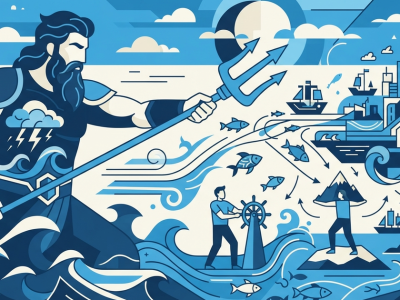
Defining Poseidon’s physical traits is not as simple as describing a stable body, because a Greek god’s appearance is mediated through poetry, cult practice, objects, coins, and regional artistic habits. This essay therefore treats Poseidon less as an anatomical figure with one authoritative form and more as a religious image made recognizable through repeated attributes. His trident, forceful battle posture, association with horses, and links to bulls give him a recognizable visual and symbolic identity, yet those traits do not appear with equal emphasis in every context. Different media and communities could foreground different aspects of the god: marine power, earthquake force, martial strength, fertility, or local cult identity. Using recent peer-reviewed scholarship, this essay argues that Poseidon’s physical traits are best interpreted as a flexible iconographic and cultic attribute system rather than a fixed anatomical portrait.
Attribute Clusters, Not Anatomy
Poseidon’s physical identity becomes recognizable through recurring attributes rather than through one complete bodily description. In the ceramic Gigantomachy scenes discussed by Boer et al. (2022), the god is identified through action and equipment: he attacks Polybotes with a trident while carrying the huge rock torn from Kos. That image gives Poseidon a forceful body, but it does so through pose, weapon, and geological burden rather than through stable facial or anatomical features. Other evidence works the same way. Denk (2018) shows that archaic coinage at Potidaea presented the city’s patron as Poseidon Hippios, while Becker (2024) links Poseidon to the magnificent white bull sent to Minos. Across these cases, the god’s “look” is built from a cluster of signs: trident, rock, horse identity, and bull association. The result is partial visual stability, not a single canonical body.
The trident is therefore central but not sufficient as a definition of Poseidon’s physical traits. It can function as a compact sign of divine agency, especially in the Kos battle tradition where repeated ceramic depictions show Poseidon killing Polybotes with it (Boer et al., 2022). Yet treating the trident as the whole of Poseidon’s appearance would flatten the evidence. Elema (2025) argues for Greek gods as fluid figures whose forms need to be read across time, space, environment, and social meaning, and Denk (2018) similarly emphasizes the varied spread of Poseidon’s cult and divine character across the Greek world. The recurring motifs matter because they prevent Poseidon from dissolving into pure variability. Still, they identify him by adaptable attributes, not by an unchanging physical template.
Martial Iconography and Environmental Force
Poseidon’s most direct physical profile emerges where his body is shown in violent motion. Building from the trident as a key identifier, the Polybotes battle scenes make the weapon part of a larger martial pose rather than a detached symbol. Boer et al. (2022) note that dozens of surviving ceramic objects depict the legendary battle on Kos, with Poseidon killing Polybotes by trident while also carrying a huge rock torn from the island. The god’s “physical traits” in this tradition are therefore not facial details or proportions, but a battle-ready body organized around weapon, raised burden, and destructive action. This matters because the ceramics present Poseidon as recognizable through force: the trident strikes, the body carries geological mass, and the image turns divine identity into movement. In this evidence, Poseidon’s body is a vehicle of punishment and environmental power.
That martial body also links Poseidon’s appearance to disaster imagery. The rock-bearing figure is not only a mythic combat pose; it parallels an interpretation of the legend as memory of a strong earthquake that caused a coastal rock fall or rock avalanche on Kos (Boer et al., 2022). Geological evidence strengthens that reading, since studies identify a large, relatively recent rock avalanche on the southeast side of Zini mountain and boulders stranded up to 6 m above sea level on the opposite coastline (Boer et al., 2022). In this context, Poseidon’s body does symbolic work: it translates earthquake, noise, dust, falling rock, and possible coastal inundation into the visible form of a god carrying and weaponizing stone. Elema (2025) helps explain why such attributes could shift with mortal needs and environmental experience. The image makes Poseidon physically legible as disaster personified.
Still, the battle image should not be mistaken for a complete or timeless portrait of Poseidon. Its strength is also its limit: the reconstruction depends heavily on surviving ceramic media and on a chronology that is itself partly inferred from those ceramics. Boer et al. (2022) date the oldest ceramic representations of the disaster to about 540 BCE and state that, in the absence of suitable geological dating methods, ceramics provide the best chronology for the event. That makes the evidence powerful but conditional. Broader method matters here, because Poseidon’s traits look different when examined through sanctuaries, coinage, cult buildings, myth, history, and literary evidence rather than through painted battle scenes alone (Denk, 2018; Elema, 2025). The Polybotes tradition therefore gives the clearest visual image of Poseidon’s destructive body, but not the whole range of his physical identity.
Animalized Masculinity and Symbolic Power
Poseidon’s physical traits also carry a masculine symbolism of domination, but that symbolism is cultural rather than simply anatomical. The battle body from the Polybotes tradition presents divine masculinity as overpowering force: Poseidon kills with the trident while carrying the torn rock as a weapon of burial and defeat (Boer et al., 2022). Yet the same logic extends beyond human-shaped combat. In the Minos myth, Poseidon sends a magnificent white bull whose beauty makes Minos unwilling to sacrifice it; the god’s punishment then produces Pasiphae’s unnatural desire and the Minotaur, a hybrid offspring tied to the bull’s potency (Becker, 2024). These examples make Poseidon’s “body” larger than his own limbs. His physical identity includes animal force, reproductive consequence, and punitive power. At the same time, Elema (2025) qualifies any purely biological reading by treating divine attributes as fluid cultural signs. Poseidon’s masculinity is therefore an iconographic language of force, not a fixed male body.
This symbolic body matters because Poseidon’s traits translate human vulnerability into visible divine form. As the earlier discussion showed, the trident, rock, Hippios identity, and bull associations make Poseidon recognizable, but they do not amount to one stable portrait. Elema (2025) argues that shifts in mortal need are reflected in the attributes through which gods were worshipped, and that reading ancient descriptions beyond surface assumptions can uncover deeper meaning. That framework fits the earthquake reading of the Kos legend: the rock-bearing Poseidon gives mythic shape to a terrifying coastal rock avalanche, its noise, dust, and possible tsunami effects on nearby inhabitants (Boer et al., 2022). It also fits the Minos bull episode, where beauty, disobedience, animal desire, and punishment are compressed into one symbolic narrative (Becker, 2024). Poseidon’s traits thus mark not only what he looks like, but what divine power feels like to communities exposed to force, fear, and judgment.
Regional Cult and Historical Change
Regional cult evidence shows that Poseidon’s visible traits depended on local religious settings rather than on one uniform Greek image. The Chalcidice evidence is especially important because Poseidon’s worship there appears in distinct local forms: Cape Poseidi functioned as an extra-urban sanctuary of Mende, while Potidaea presented its patron god on archaic coinage as Poseidon Hippios, with a temple outside the city (Denk, 2018). That local Hippios identity foregrounds the horse-associated Poseidon more than the rock-bearing or bull-linked forms discussed earlier. Elema (2025) supports this reading by treating divine figures through time, space, and cultural environment rather than as fixed beings. The qualification is important, however: for ancient Macedonia, only two securely identified sanctuaries of Poseidon are known, both in Chalcidice (Denk, 2018). Regional variation is therefore real, but it must be argued from uneven evidence.
Chronology further explains why Poseidon’s traits cannot be reduced to one period’s artistic conventions. Denk (2018) places Poseidon’s multifaceted cult deep in the Aegean Bronze Age, and the Cape Poseidi sanctuary includes an ash-altar dated to the 12th century BC and an apsidal cult building dated to the 10th century BC. By contrast, the Kos disaster tradition becomes visible in ceramics much later, with the oldest representations dating to about 540 BCE (Boer et al., 2022). This gap does not weaken the argument for Poseidon’s flexible traits; it explains it. Long-lived worship created the conditions for changing local images, while later media crystallized particular traits for particular stories. Still, Boer et al. (2022) caution that ceramics provide the best chronology only because suitable geological dating methods are lacking. The timeline is persuasive, but not absolute.
The strongest method, then, is interdisciplinary, though it cannot produce certainty about every physical trait. As earlier sections showed, ceramics, coinage, sanctuaries, and cult buildings preserve different aspects of Poseidon’s identity; no single medium contains the whole god. Elema (2025) makes this approach explicit by arguing that literary descriptions, archaeological evidence, and artistic representations together create a more realistic picture of Greek cult worship. Denk (2018) similarly frames the Chalcidice study as a preliminary sketch built from archaeology read alongside myth, history, literature, and numismatics. Yet the broader the comparison becomes, the more careful the reconstruction must be. Daniels (2023) shows that Poseidon can appear in wider cross-cultural religious reference contexts without necessarily yielding detailed evidence for his physical traits. Interdisciplinary scope strengthens interpretation, but it also marks the limits of trait-specific reconstruction.
Conclusion
Poseidon’s physical traits are best understood as a recognizable but adaptable system of attributes, not as a single fixed divine body. The preceding analysis has shown that his identity could be made visible through the trident, the rock-bearing battle pose, horse associations, bull symbolism, and local cult forms, but none of these signs alone defines him completely. Each medium and setting preserved a different aspect of divine presence: ceramics emphasized destructive motion, cult and coinage foregrounded regional identity, and mythic animal imagery translated power, punishment, and fertility into symbolic form. This flexibility does not make Poseidon visually vague. Rather, it explains how Greek communities could recognize the same god while reshaping his appearance around local needs, historical memory, and religious meaning. Poseidon’s body, therefore, is not a stable anatomical portrait but a changing visual language through which Greeks imagined force, authority, environment, and divine agency.
-
{"bio": "Science belongs to everyone, not just laboratories. As a research educator and science writer, I create comprehensive essay examples on biological and environmental topics that make science approachable, inspiring, and actionable. With a Ph.D. from Berkeley and over 10 years of science communication experience, I help students and curious minds at Litero understand the natural world through well-crafted, evidence-based writing.", "expertise": ["Content Writing", "Research Synthesis", "Peer Review", "Scientific Journalism"], "connections": [{"platform": "linkedin", "url": "www.linkedin.com/in/dr-sofia-m-rivera-067aa5432"}, {"platform": "orcid", "url": "https://orcid.org/0009-0001-0458-4053"}]}
-
{"bio": "Literature is the mirror of our society, and I believe every Filipino student deserves to see themselves in their academic work. As a research writer and humanities educator at Ateneo de Davao, I develop essay examples grounded in Philippine literature, history, and cultural studies that are both academically rigorous and deeply relevant to Filipino learners. My work bridges traditional scholarly writing and the rich oral and written traditions of the Philippines.", "expertise": ["Content Writing", "Literature", "Humanities Research", "Creative Non-Fiction"], "connections": [{"platform": "linkedin", "url": "www.linkedin.com/in/angelica-f-buenaventura-m-a-92a8bb42b"}, {"platform": "orcid", "url": "https://orcid.org/0009-0003-0117-1055"}]}